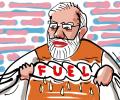
Following through announcements with enforcement of measures is key, as a run through recent Indian economic history shows, points out A K Bhattacharya.

The United States and Iran concluded the first phase of in-person talks in Islamabad, with both delegations exchanging written texts to formalise areas of understanding. The discussions, involving key representatives from both sides, are aimed at reducing tensions and exploring possibilities of a structured understanding.

The economic fallout of the West Asia crisis, the prevailing security situation in the Indo-Pacific and ways to boost cooperation in critical minerals and technology are expected to top the agenda at a crucial meeting of the Quad foreign ministers on Tuesday.

The Confederation of Indian Industry (CII) has proposed a 20-point policy agenda to the finance ministry, including a conflict-linked emergency credit line guarantee scheme and tax rationalisation on energy inputs, to support MSMEs, exporters, and energy-intensive industries affected by the ongoing West Asia war.

Petrol and diesel prices in India have seen their fourth increase in less than two weeks, pushing cumulative hikes to nearly Rs 7.5 per litre since May 15, reaching their highest levels since May 2022. This surge, driven by global crude oil costs and the Iran conflict, is expected to exacerbate inflationary pressures and raise transportation costs across the economy.

The US military carried out 'self-defence strikes' targeting Iranian missile launch sites and boats near the Strait of Hormuz, even as President Trump announced progress in ceasefire negotiations, stating Iran's enriched uranium will be 'turned over' or destroyed.

The United States has redirected 48 vessels in the Persian Gulf, particularly in the Strait of Hormuz, over the past 20 days amid ongoing enforcement actions related to restrictions on Iranian maritime assets by the US Navy.

India emerged reasonably well from 2025. But now, the oil shock and war-related supply disruptions have again driven funds out of India and significantly weakened the rupee, points out Ajay Chhibber.
Iran has submitted a fresh proposal to regional intermediaries offering to cease its military operations in the Strait of Hormuz, contingent upon a complete cessation of hostilities and the removal of the US blockade on Iranian maritime hubs.
The federal probe agency has also called for documents and the recording of statements of some company executives under provisions of the FEMA, they said.

A Pakistani delegation, led by Army Chief Field Marshal Asim Munir, has arrived in Tehran to mediate the ongoing conflict between the US and Iran, following initial talks in Islamabad.
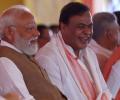
Himanta Biswa Sarma's return as Assam's Chief Minister underscores the BJP's increasing dominance in the northeast, marked by both development and divisive policies.

An Iranian delegation, led by Foreign Minister Abbas Araghchi, is expected to arrive in Islamabad for the second round of peace talks with the US, according to Pakistani media reports. This follows a phone call between Deputy Prime Minister Ishaq Dar and Araghchi regarding the US-Iran ceasefire and Pakistan's diplomatic efforts.

Pakistan's Prime Minister Shehbaz Sharif has offered to mediate between the US and Iran to de-escalate the ongoing conflict in West Asia, following a joint US-Israel attack on Iran. Sharif has been in contact with Saudi Arabia, the UAE, and other nations to promote dialogue and diplomacy.

Border trade between India and China through the Lipulekh Pass in Uttarakhand's Pithoragarh district is set to resume this year after a six-year hiatus due to the COVID-19 pandemic.

According to the Economic Survey 2026, the appropriate stance for 2026 is therefore one of strategic sobriety rather than defensive pessimism.
Pakistan's Prime Minister Shehbaz Sharif has engaged in extensive diplomatic efforts to de-escalate the conflict in West Asia, offering to host talks between the US and Iran and engaging with leaders from Saudi Arabia, Qatar, Malaysia, the UK, China, and the European Union.

The big question is whether Trump is any longer in command of the situation. For all practical purposes, the war seems set to cascade as the US is preparing for a potential ground operation in Iran and threatens to destroy 'bridges next, then electric power plants', points out Ambassador M K Bhadrakumar.

Delhi should keep all its options open in what is essentially a transitional period in the geopolitics of energy rather than remain a gatekeeper serving Trump's 'America First', suggests Ambasssador M K Bhadrakumar.

The LPG squeeze on India's restaurant sector is the quotidian face of a deeper crisis.
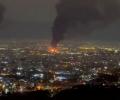
To be sure, Trump is furious, as the trajectory of the war is in a state of Zugzwang, as chess players call it. Trump and Netanyahu stare at two choices -- retreat in humiliation and concede Tehran's demands -- recognition of its rights, reparations, and binding security guarantees -- or perish in a quagmire, points out Ambassador M K Bhadrakumar.

The intriguing bit is that Trump is likely to attend the talks in Islamabad this weekend -- if he does, it will be the clearest signal yet that the US is ready to exit the war with some sort of win to show, since he cannot afford to go for the talks and return empty-handed, notes Prem Panicker in his must read blog on the Iran War
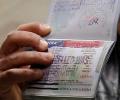
The Trump administration is proposing to limit the duration of visas for foreign students and media personnel in the US, potentially impacting their ability to stay in the country.

The United States, which entered this war in expectation of a short, sharp win along the Venezuela model, is now preparing for deeper involvement in a conflict it does not fully control, without the allies it typically relies on, against an adversary that is not behaving as expected, in a global environment that is already absorbing economic shock. Prem Panicker continues his must read daily blog on the Gulf War.

Indian equity markets closed higher, driven by gains in PSU bank, auto, and financial stocks, following the US Supreme Court's decision on tariffs. Sensex climbed 479.95 points to 83,294.66, and Nifty advanced 141.75 points to 25,713.

The 'rescue' operation occurred within kilometres of Iran's underground tunnel complex at Isfahan, assessed by the IAEA and US intelligence as holding a substantial portion of the country's 60 per cent enriched uranium stockpile. Retired senior US military officers have highlighted that the mission's footprint -- hundreds of special operators, multiple heavy-lift aircraft deep inside Iran -- appears outsized for recovering a single airman. Prem Panicker continues his must read blog on the Iran War.

Alliances fight wars effectively only when they share an endgame. If Israel acted without US knowledge, then the military alliance is operating without real coordination at the level of strategic targeting. Neither picture is reassuring in a war that is no longer regional in its consequences. Prem Panicker continues his must read daily blog on the Gulf War.

Fight on toward goals that keep receding, or exit with most objectives unmet. Trump is agitated, his poll numbers falling below the Plimsoll line, his base fractured between those who back the war and those who remember that he campaigned on ending them.

Sensitive issues remain. Water sharing of the Ganga and Teesta rivers. Treatment of minorities, particularly Hindus. Border management. Trade imbalances. Connectivity projects.What happens next will shape not just bilateral ties, but the balance of South Asia itself, points out Ramesh Menon.

Iran is fighting a different war: Older, slower, and in some ways more dangerous. Iran doesn't need to shoot down an F/A-18. It only needs to make the Strait of Hormuz feel dangerous long enough for insurance markets, shipping companies, and oil futures traders to do the rest. Prem Panicker continues his must-read daily blog on the war in the Middle East.

Baghaei also alleged that recent unrest in Iran was fuelled by foreign interference, claiming riots were triggered by "very evident" interventionist remarks by US and Israeli officials.

From the 30-Sensex firms, Tata Steel, Asian Paints, Trent, State Bank of India, Hindustan Unilever, UltraTech Cement, ICICI Bank and Bharti Airtel were among the gainers. On the other hand, Infosys, Bajaj Finance, Bharat Electronics, Larsen & Toubro and HDFC Bank were the laggards.
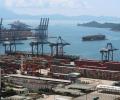
With the Iran war escalating sharply and crisis deepening in the global energy market, India on Monday unveiled a coordinated plan to support exporters and shippers caught in the fallout.
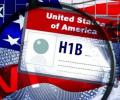
The United States Embassy in India on Monday said starting December 15, the United States has 'expanded' online presence reviews to all H-1B and H-4 applicants as part of standard visa screening, and this vetting is being conducted globally for 'all applicants of all nationalities' for these two visa categories.
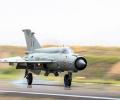
The MiG-21 episode demonstrates that procurement is always strategic.
Choices about what aircraft to acquire, who builds them, who supplies the spares, who trains the pilots and technicians are decisions with political consequences lasting for decades.

Harvard University has filed a lawsuit against the Trump administration over its decision to revoke the university's certification to enroll foreign students. The lawsuit claims that the government's action is unlawful and unwarranted and that Harvard is not Harvard without its international students. The university argues that the government's decision will have a devastating effect on Harvard and its thousands of international students. The lawsuit comes a day after the Trump administration ordered the Department of Homeland Security to terminate Harvard University's Student and Exchange Visitor Program (SEVP) certification.

Amid US-China trade tensions and economic vulnerabilities, India must seize the 'China +1' opportunity, deepen reforms, secure FTAs, and globalise its firms for long-term growth, suggests Ajay Shah.
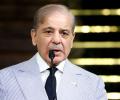
United States President Donald Trump is set to engage in high-stakes bilateral meetings on Thursday, including a closed-door session with Pakistan's Prime Minister Shehbaz Sharif in the Oval Office, according to Trump's public schedule released by the White House.

Prime Minister Narendra Modi visited Ethiopia on a bilateral visit, engaging with Ethiopian leadership to strengthen partnerships in various sectors. He was warmly welcomed by Prime Minister Abiy Ahmed Ali and participated in cultural events, highlighting the strong ties between the two nations.
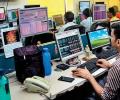
From the 30-share pack, Bajaj Finserv, Mahindra & Mahindra, Eternal, Power Grid, ITC, Tata Motors, Asian Paints and Hindustan Unilever were among the gainers. Among the laggards, Kotak Mahindra Bank tanked 4.57 per cent
 © 2026 Rediff.com - Advertise with us - Disclaimer - Privacy Policy - Sitemap - Feedback - About us - Terms of use - Grievances